Friday, November 20, 2009

Radiohead is just OK (Computer)

SPIN this month published a list entitled “16 Rock Myths Debunked,” leading off with “Myth No. 1: Radiohead Can Do No Wrong.” It’s a myth that’s long deserved some discussion, despite most music fans’ unwillingness to question Thom Yorke and his mates. As writer Chris Norris notes, “sometimes the elephant isn't in the room, but onstage.”


Norris broaches the sensitive subject with all the subtlety of a sledgehammer, saying, “In some ways, when you think about it…Radiohead kinda blow.”

“At last year's All Points West festival, as their thin, stubbly faces filled massive video screens, Radiohead began their set with In Rainbows' "15 Step": an open-ended groove with a quirky electro beat, two-chord motif, and airy, abstract singing. Then they did the 2001 song "Morning Bell/Amnesiac": an open-ended groove with a quirky electro beat, two-chord motif, and airy, abstract singing. Then they kept going, one groovy tone poem into another, masterfully weaving beats, sound-washes, and misty vocals into an immersive experience of sound, light, pattern, rhythm, and utter, paralyzing boredom. By the encore, it was obvious what Radiohead had become: an exceptionally well-dressed jam band. That you can't even dance to.”

However, he then goes on to waffle about, essentially backing off on his previous statement and explaining that Radiohead used to be the greatest band ever, but In Rainbows was disappointing and caused him to rethink his fandom.

The truth about Radiohead lies somewhere in between.

I appreciate the sentiment of “Radiohead kinda blow.” It’s the kind of thing one needs to say in order to combat the legions of people who think Radiohead have surpassed The Beatles in terms of musical ability and historical significance. Saying, “I don’t care for Radiohead” -- and optionally adding, “It insists upon itself” -- will only earn the holder of such opinions a Scarlet Letter of Musical Incompetence. To dislike Radiohead is to love Nickelback, Kid Rock and The Jonas Brothers, as far as those in the know are concerned, so questioning the group’s music outright might be the best path to take.

The problem is, Radiohead doesn’t blow.


The real heart of the matter: Radiohead inspires a kind of unwavering loyalty that no band should deserve. No band, save for perhaps The Beatles, has enjoyed such a perfect career that it deserves to be called “the only band doing anything new” or some similar hyperbole.

Plenty of bands show flashes of greatness, push the envelope, or just record a great album. Only a few have been blessed enough to gain so much notoriety for their efforts, and Radiohead counts itself among that select group. Worshipping Radiohead above all others for it is a disservice to the vast amount of amazing music that exists beyond the bubble of OK Computer.

“Blasphemy!” they say. “This one doesn’t understand that OK Computer is the best album in history! He must be burned!”

If I am to be a martyr for the cause of keeping Radiohead’s constantly inflating reputation as the greatest modern band in check, then so be it. No band is deserving of such singular adoration, not even a good one like Radiohead.

Radiohead is a band of millionaires, dudes so rich that they can afford to release albums for free. So go ahead and spread the love a little. Buy some albums by “lesser” bands. The guys in the band won’t miss you for those brief moments you choose to spend listening to someone else’s record. They probably won’t even hold it against you if you come to realize, somehow, that there is a world of sound beyond the dulcet tones of Thom Yorke’s incomparable voice.

Radiohead can do wrong, and knowing it is liberating. I have the freedom to take it in stride when Thom Yorke stumbles. When the band’s next record is disappointing, I won’t have to listen to it 37 times in a row, waiting for its genius to become apparent. I’ll be able to simply move on to something better.

Thursday, November 19, 2009

Film Review: Pirate Radio (The Boat That Rocked)

British ensemble comedy The Boat That Rocked, retitled Pirate Radio for American audiences, has suffered at the hands of critics on both sides of the pond. The film, about a group of DJs running a pirate radio station from a boat off the shore of 1960s England, has earned a 54% rating on Rotten Tomatoes.


I have no desire to argue with the detractors. Pirate Radio is clearly flawed, a jumble of incoherent plot fragments and poorly developed characters (what the hell was Ike Hamilton’s character’s job on the boat?). The ending is at odds with the tone of the rest of the film, and the film’s premise is not nearly as historically accurate as it would lead audiences to believe. Finally, it was still a little lengthy despite a recutting for the American version.

And yet, at the same time, it’s a joyous celebration of some great rock ‘n’ roll. Never mind that some of the song choices are a little hackneyed. The Kinks’ “All Day and All of the Night” isn’t exactly a forgotten gem, but who wouldn’t want to hear it again? The Rolling Stones, Small Faces, Jimi Hendrix, Jeff Beck, Otis Redding, Cream, The Beach Boys, and Martha & The Vandellas are just a few of the classic artists featured on the soundtrack.


Several songs make strong contributions to the film’s tone. Cat Stevens’ “Father and Son” makes a logical and powerful appearance.

One minor complaint about the music selections: at least one song was not period appropriate. The movie, set in 1966-67, predates The Who’s “Won’t Get Fooled Again” by a good four years. British soul revivalist Duffy also makes an appearance, but she’s covering an older song.

The amount of rock cred bursting from the movie doesn’t stop at its soundtrack. The cast of characters on the boat embody the rock ‘n’ roll lifestyle, from Midnight Mark’s legendary silence to Gavin’s distinctive on-air voice, from Dave’s rampant sexual appetite to Bob’s burned out demeanor.

It’s already clear how important rock is to the DJs, considering they’re willing to seclude themselves on a boat for its sake, but the numerous scenes of characters simply dancing to the music cements that fact.

Philip Seymour Hoffman plays The Count, the American member of the crew of DJs. Hoffman, as an actor, has a generous helping of inherent cool that allows him to believably portray characters like this. I’ve seen Almost Famous so many times that, as far as I’m concerned, Hoffman actually is Lester Bangs. And The Count loves the music so much that he’d be willing to die for it.

Music fans will likely find little to complain about while leaving the theater. This is a movie about the joy of music. Plenty of films have examined the joy of making music, but this one delves deep into the amount of pleasure that can be derived simply from listening. That pleasure is catching.

HIPNESS RATING: 5/10
ACTUAL RATING: 7/10

Is 'Bad Lieutenant' Nicolas Cage’s best role in years?


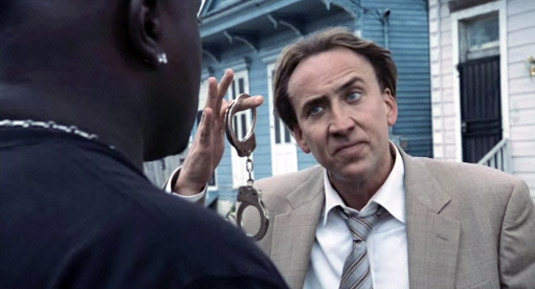
Director Werner Herzog has remade a tale – the 1992 Abel Ferrara micro-cult indie cop drama Bad Lieutenant starring Harvey Keitel – that never warranted a revisit. The result is Bad Lieutenant: Port of Call New Orleans, starring Nicolas Cage as an imbalanced corrupt cop with more vices than a carpenter’s woodshop and a paranoid fear of iguanas. Apparently the only similarities between the two films are the title and the presentation of an immoral drug addict. In grand idiosyncratic fashion, Herzog reportedly commanded Cage on the set to “turn the pig loose!” Herzog told the Toronto Star: “He immediately knew what I meant. And man, does he turn the pig loose! As an actor, he always understood the fluidity of the situation. The kind of musicality, jazz in particular, which allows you to improvise and stay within a certain mood and go wild.”

In the past decade, Cage has been a victim of disparagement and derision from audiences for his schlocky acting roles. The Wicker Man, Ghost Rider, Next, Bangkok Dangerous, Knowing. The worse the film, the wackier his stylized coif.

While reviews for Lieutenant are on-the-whole very positive, critics are either praising Cage’s Frank Booth-esque tour-of-force of mayhem or dismissing his ability to act at all. Regardless, his portrayal of Terence McDonagh qualifies as his most challenging role since his 1996 Oscar-winning turn in Leaving Las Vegas.

More after the jump.

Cole Smithey writes that Cage loses control of the character, slipping into an “off-putting vocal delivery late in the story,” which further distracts from the patchwork plot. “Cage even goes so far as to tear a page from Klaus Kinski's relationship with the camera,” he says, “but the tribute is as inappropriate as making a sequel to a film to which there could never be a follow-up. A disaster.”

Roger Ebert, who swam against the current in awarding Cage’s film Knowing four stars in March, comes to the actor’s defense. He argues that Cage and Herzog, “both made restless by caution,” were born to work together and gives this film four stars as well. “No one is better at this kind of performance than Nicolas Cage. He's a fearless actor. He doesn't care if you think he goes over the top. If a film calls for it, he will crawl to the top hand over hand with bleeding fingernails.”

Andy Klein of Brand X breaks the opposing camps down into how they’ll perceive this film. “Cage’s affectations are always daring, if not always successful. His contorted posture rightfully reminds us that he is always one inch away from excruciating back pain, but a shift in his manner of speaking for several scenes around the three-quarter mark is simply baffling. Your reaction to the whole thing probably depends on your general feelings about Cage: Fans will relish his unique brand of scenery-chewing; non-fans are likely to be irritated.”


Wednesday, November 18, 2009

Apollo guest blogger reviews 'The Twilight Saga: New Moon'

[EDITOR’S NOTE: We have a guest blogger today – Victoria, a new London correspondent for Apollo’s Cred. Keep an eye out for her byline. Her first article is a review of the divisive new Twilight film…The Twilight Saga: New Moon. Seriously though, no one on staff had the courage to see this. As always, give us your feedback!]


New Moon is the second installment of the vampire romance Twilight series, based on the books by Stephanie Meyer. Director Chris Weitz (The Golden Compass, About a Boy) took the helm with this film, replacing Catherine Hardwicke. He stayed quite faithful to the plot of the text but managed to speed up the pace of the film, making it quite interesting and enjoyable to watch.

The story takes us from where it ended in Twilight: Bella, a very simple teenage girl, totally in love with Edward Cullen, not only the most handsome boy in the school, but also a vampire and the most ideal man in Bella’s universe. However, their relationship is darkened and complicated by some "ordinary" problems of vampire-world, and Bella is forced to suffer through the emotional troubles of the break-up. Apart from the fact that the boy is a vampire, this story is very ordinary and has happened to every girl. Weitz should get credit for understanding this.

He shifts the genre of the film saga more towards chick-flick or female Gothic rather than vampire horror, which seems quite appropriate as the main audience is comprised largely of teenage girls. He understands girls and gives them what they want: In contrast to Twilight, New Moon has more kisses, more romantic talks that are supposed to make you cry or say “awww” and (oh yes!) more naked torsos. Sorry boys, these are only men’s naked torsos. So, for the target audience, this film is a great treat.

New Moon brings more attention to the story of werewolves and the Bella-Jacob relationship. Jacob Black, of course, is the nice boy/werewolf who helps Bella through her breakup with Edward. The werewolves' action scenes are beautifully done and fascinating to watch even if you are not a fan of the Twilight mythos. The relationship between Bella and Jacob acts as the central one in the film, which is good, as it is not as straightforward as Bella and Edward’s love. It gives the audience a chance to see some acting from Kristen Stewart and novitiate Taylor Lautner. Over the course of the film, Robert Pattinson musters a range of two to three expressions, which is probably his -- or the director’s -- idea of how an ideal man (oops!) ideal vampire should look. It is a shame because he is a good actor and certainly can pull out a wider range of different expressions, as he proved in Little Ashes.


The film's other cast members are very interesting to watch: Michael Sheen simply shines as one of the Volturi vampires, and Billy Burke as Bella’s dad proves again that he is probably the only believable human on the screen.

The cinematography of New Moon (courtesy of director of photography Elliot Davis) is starkly different from Twilight – it’s more colorful, sharp and light. That again proves the director’s intentional shift from a spooky film towards chick-flick.

The films make the world look almost dull, unchallenging and simple when compared to the books. That is, however, the problem with all mass and pop-production, whether it’s fast food or films. While it is enjoyable to consume once in a while, I hope it doesn’t become our everyday diet.

- Victoria Russo


Tuesday, November 17, 2009

Curb Your Enthusiasm: Season 7 Rundown


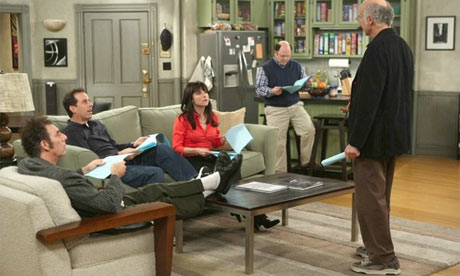
Season-long arc: The Seinfeld Reunion. Larry attempts to win back his estranged spouse Cheryl by going to work on a Seinfeld reunion and casting her in the role of George’s ex-wife.

Best: “The Table Read,” “The Reunion,” “Funkhouser’s Crazy Sister”
Worst: “The Hot Towel,” “The Black Swan”

# of subplots related to tipping: 4. (If counting Rosie and LD's dispute over who's covering a check for lunch, then 5.)
Underused supporting regulars: Richard Lewis, Wanda Sykes and Shelley Berman (as Nat David).
Overused supporting regulars: Bob Einstein (as Marty Funkhouser) and Susie Essman.

LD at his most outrageous: Pulling down his pants at Jeff’s house in front of a police officer, Jeff and Susie, in order to reveal he is wearing skimpy women’s underwear and thus exonerating Jeff of blame. Susie had previously found women’s underwear in Jeff’s car glove compartment, which he unusually pinned on Larry.

Most overstuffed episode: “The Bare Midriff” A gory ‘60s flashback that was better suited to the cutting room floor for Mad Men. Director Larry Charles managed to squeeze his Atheist leanings into a bit about splashing urine.
Episode that most closely resembled a ‘Seinfeld’ narrative: “The Reunion”
Best episode ending: LD gripping onto his assistant’s protuberant belly as he hangs off the roof of a building in “The Bare Midriff.”

Best race-related gag: Michael Richards’ outburst on a studio back lot, shouting on Leon for impersonating a Jewish accountant offering advice on Groat’s Disease in “The Table Read.” A crowd gathers and they record it on their cameras and cell phones – the event parodying Richard’s real-life racist explosion in a comedy club three years ago. Runner-up: LD, Leon and Loretta argue about the house’s temperature. Leon likes it at 82; LD in the 60s. A hilarious observation.

Strangest celebrity cameo: Christian Slater
Member of the Seinfeld Four with the funniest improv-ing: Jerry Seinfeld. His eloquent delivery, zingy banter and overall affability made him the nice guy, white collar counterpart to LD, the dirty-work engineer of social unconvention.

Most active director: Larry Charles, former Seinfeld writer and director of Borat, Bruno and Religulous, with three episodes. The bearded gent took over for Robert B. Weide, a former regular Curb director who left the show at the end of last season.

The season’s most completely far-fetched scenario: The scene in which LD’s bare-midriffed assistant and her mother hear a noise around the back of an office building. They run to check it out, bumping into LD who is urinating on the wall (because the building is locked). The splashiness of his actions immediately alerts the assistant of a horrifying relevation: LD desecrates the Jesus painting in their bathroom; Jesus was not crying. The assistant’s mother runs to the roof to attempt suicide. (“The Bare Midriff”)

Master of the writer’s domain: Larry David

NOTE: How incredibly meta would it have been if the Seinfeld reunion revolved around Jerry and George’s twice-failed sitcom idea?

The season finale airs this Sunday at 9 p.m. on HBO.

Wednesday, November 4, 2009

Auto-Tune: Homogenizing popular music?

On Nov. 4, CBS Evening News ran a story about the rising trend of Auto-Tune in music. The report depicts the popular vocal effect as a creeping disease that all music fans should fear, which seems a little harsh.

Auto-Tune, of course, is the robotic-sounding vocal effect that Cher introduced to the mainstream, T-Pain used to build his career and Kanye West leaned on heavily for 808s & Heartbreak.

It's true that Auto-Tune has been masking vocal imperfections on studio albums for years. When it's at its most subtle, Auto-Tune allows producers to tweak slightly off-key notes, making the vocal performance sound closer to perfect. Some singers even use Auto-Tune during live performances. It may seem a little dishonest, but it shouldn't be any surprise that musicians use any means necessary to make their albums sound better.

The CBS report suggests that people are worried Auto-Tune is too pervasive, that it's homogenizing popular music. Unfortunately, it's far too late now to worry about mainstream pop losing its edge.

The homogenization of pop music has its roots in the early days of rock 'n' roll. In the '50s, it was common practice for white artists to record sanitized versions of black artists' songs. In several cases, the cover versions outperformed the originals on the charts (like Bill Haley's version of Ike Turner's "Rocket 88").

That same sanitization of music is rampant today. American Idol and the Jonas Brothers are squeaky clean and absolutely devoid of human quirks and imperfections. The popular television series Glee has taken several classic rock staples and drained them of their character, transforming them into easily digestible yawnfests. What's a little Auto-Tune when the Top 40 has already been successfully robotized?

Anyway, it still takes the same amount of craft to write a good song, Auto-Tune or not. An Auto-Tuned vocal is essentially the same as a synthesizer. It's still up to the songwriter to come up with a melody that people want to hear. Though Auto-Tuning may mask vocal imperfections, it's hardly magic.

See Ron Browz' "Jumpin' (Out the Window)" for proof of Auto-Tune's inability to make up for a lack of musical talent. Just because it lets a producer manipulate vocals to hit the notes he chooses doesn't mean the producer will pick the right notes.

Low-fi recordings will always have a place in popular music, even if they exist on the periphery. The CBS report shows a group that eschews Auto-Tune and paints it as an anomaly. However, The White Stripes' early albums were recorded in a studio that contained only vintage equipment.

Auto-Tune may not have had the most positive impact on the face of pop music, but it hardly signals the death of real flesh and blood in music.

Tuesday, November 3, 2009

The decade that Rivers failed


The shortcomings of Weezer amount to more than just a bassist switch-up. It’s become a grim, quixotic spectacle.

Frontman Rivers Cuomo’s shrugging off his Harvard degree and his musical talent, it seems, to be a lot like Phil (played by Ty Burrell) from the ABC sitcom "Modern Family," the middle-aged dad with his youth cryogenically preserved on the inside, trying to please everyone, and in turn, please himself. Phil’s sometimes as wide-eyed as a little kid or salivatory as the feral, airborne canine on the cover of Weezer’s Raditude (coined by actor Rainn Wilson), the seventh album out today.

Cuomo’s a little different from Phil in that he longs to be “the greatest man that ever lived” and live in Beverly Hills. In spite of his denial, he’s a melancholy, tortured genius who’s lost his spark and instead gained the will to pander. Contradictions in the catalogue are abundant: Weezer was “tired of sex” in 1996 but says quite the opposite in Weezer (The Red Album)’s “Cold Dark World" ("I'll be here to sex you.") “In the Garage” tells of how Rivers grew up listening to good music; “Heart Songs” tells of how Rivers grew up listening to not-so-good music.

After all these years, Rivers’ signature quavering voice remained (ironically) constant, a lasting selling point among the pitter-patter of questionable creative decisions. His voice scarily sounds pubescent on this record, unfortunately evoking a emo pitch on “Put Me Back Together.” Weezer has new friends these days: All-American Rejects, Butch Walker and Jermaine Dupri, who all co-wrote songs. A band that could’ve collaborated with Dr. Dog or The Hold Steady has instead teamed up with the radio.

Cuomo’s innocence and vulnerability were always a part of his charm – then he creeped us out when he cultivated a mustache and donned a cowboy hat for Red. Cuomo’s still channeling his imperfect formative years, which was oh so relatable, but with Raditude, he’s managed to reimagine his teen years as if he was still going to high school in 2009. Songs, “In the Mall,” “The Girl Got Hot,” and “Can’t Stop Partying,” take bland sub-urban slang to a new level. And, for what?


Early Weezer fans have become scathing watchdogs like crestfallen sports fans railing with drunken bitterness about the glory days of Blue and Pinkerton. Slant Magazine’s ½-star review of Raditude hit hard even if they all saw it coming. Huw Jones writes: “Even the most dogged members of the Weezer fanbase will struggle to mount a shred of defense for such an abhorrent cocktail of deluded lyricism and indolent musicianship.”

Fans have been shortchanged when picking up their albums in the past, but this time they may be at the end of the road. This was not made with them in mind at all.
At best, a few of the riffs stay in your head for a few days (the guilt lasts longer). The catchy deluxe edition bonus track “The Prettiest Girl in the Whole Wide World” is Blue lite. It could have easily come from one of Cuomo’s basement solo discs.

So maybe Rivers Cuomo isn’t the uncool middle-aged dad type. Maybe he’s Max Records from Where the Wild Things Are. If you block out all the noise and lose yourself in your dreams, you can still be king. Those may be words of inspiration for him, but it ain’t doin’ nothin’ for me.