Showing posts with label feature. Show all posts

Thursday, November 19, 2009

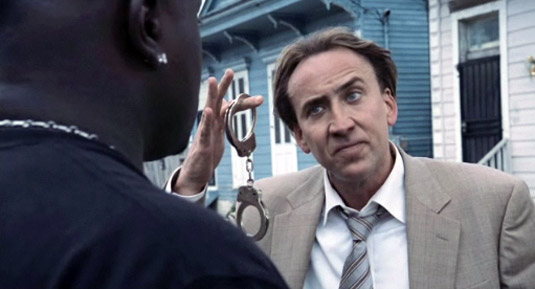
Is 'Bad Lieutenant' Nicolas Cage’s best role in years?


Director Werner Herzog has remade a tale – the 1992 Abel Ferrara micro-cult indie cop drama Bad Lieutenant starring Harvey Keitel – that never warranted a revisit. The result is Bad Lieutenant: Port of Call New Orleans, starring Nicolas Cage as an imbalanced corrupt cop with more vices than a carpenter’s woodshop and a paranoid fear of iguanas. Apparently the only similarities between the two films are the title and the presentation of an immoral drug addict. In grand idiosyncratic fashion, Herzog reportedly commanded Cage on the set to “turn the pig loose!” Herzog told the Toronto Star: “He immediately knew what I meant. And man, does he turn the pig loose! As an actor, he always understood the fluidity of the situation. The kind of musicality, jazz in particular, which allows you to improvise and stay within a certain mood and go wild.”

In the past decade, Cage has been a victim of disparagement and derision from audiences for his schlocky acting roles. The Wicker Man, Ghost Rider, Next, Bangkok Dangerous, Knowing. The worse the film, the wackier his stylized coif.

While reviews for Lieutenant are on-the-whole very positive, critics are either praising Cage’s Frank Booth-esque tour-of-force of mayhem or dismissing his ability to act at all. Regardless, his portrayal of Terence McDonagh qualifies as his most challenging role since his 1996 Oscar-winning turn in Leaving Las Vegas.

More after the jump.

Cole Smithey writes that Cage loses control of the character, slipping into an “off-putting vocal delivery late in the story,” which further distracts from the patchwork plot. “Cage even goes so far as to tear a page from Klaus Kinski's relationship with the camera,” he says, “but the tribute is as inappropriate as making a sequel to a film to which there could never be a follow-up. A disaster.”

Roger Ebert, who swam against the current in awarding Cage’s film Knowing four stars in March, comes to the actor’s defense. He argues that Cage and Herzog, “both made restless by caution,” were born to work together and gives this film four stars as well. “No one is better at this kind of performance than Nicolas Cage. He's a fearless actor. He doesn't care if you think he goes over the top. If a film calls for it, he will crawl to the top hand over hand with bleeding fingernails.”

Andy Klein of Brand X breaks the opposing camps down into how they’ll perceive this film. “Cage’s affectations are always daring, if not always successful. His contorted posture rightfully reminds us that he is always one inch away from excruciating back pain, but a shift in his manner of speaking for several scenes around the three-quarter mark is simply baffling. Your reaction to the whole thing probably depends on your general feelings about Cage: Fans will relish his unique brand of scenery-chewing; non-fans are likely to be irritated.”


Tuesday, November 17, 2009

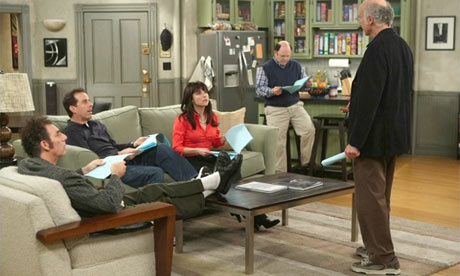
Curb Your Enthusiasm: Season 7 Rundown


Season-long arc: The Seinfeld Reunion. Larry attempts to win back his estranged spouse Cheryl by going to work on a Seinfeld reunion and casting her in the role of George’s ex-wife.

Best: “The Table Read,” “The Reunion,” “Funkhouser’s Crazy Sister”
Worst: “The Hot Towel,” “The Black Swan”

# of subplots related to tipping: 4. (If counting Rosie and LD's dispute over who's covering a check for lunch, then 5.)
Underused supporting regulars: Richard Lewis, Wanda Sykes and Shelley Berman (as Nat David).
Overused supporting regulars: Bob Einstein (as Marty Funkhouser) and Susie Essman.

LD at his most outrageous: Pulling down his pants at Jeff’s house in front of a police officer, Jeff and Susie, in order to reveal he is wearing skimpy women’s underwear and thus exonerating Jeff of blame. Susie had previously found women’s underwear in Jeff’s car glove compartment, which he unusually pinned on Larry.

Most overstuffed episode: “The Bare Midriff” A gory ‘60s flashback that was better suited to the cutting room floor for Mad Men. Director Larry Charles managed to squeeze his Atheist leanings into a bit about splashing urine.
Episode that most closely resembled a ‘Seinfeld’ narrative: “The Reunion”
Best episode ending: LD gripping onto his assistant’s protuberant belly as he hangs off the roof of a building in “The Bare Midriff.”

Best race-related gag: Michael Richards’ outburst on a studio back lot, shouting on Leon for impersonating a Jewish accountant offering advice on Groat’s Disease in “The Table Read.” A crowd gathers and they record it on their cameras and cell phones – the event parodying Richard’s real-life racist explosion in a comedy club three years ago. Runner-up: LD, Leon and Loretta argue about the house’s temperature. Leon likes it at 82; LD in the 60s. A hilarious observation.

Strangest celebrity cameo: Christian Slater
Member of the Seinfeld Four with the funniest improv-ing: Jerry Seinfeld. His eloquent delivery, zingy banter and overall affability made him the nice guy, white collar counterpart to LD, the dirty-work engineer of social unconvention.

Most active director: Larry Charles, former Seinfeld writer and director of Borat, Bruno and Religulous, with three episodes. The bearded gent took over for Robert B. Weide, a former regular Curb director who left the show at the end of last season.

The season’s most completely far-fetched scenario: The scene in which LD’s bare-midriffed assistant and her mother hear a noise around the back of an office building. They run to check it out, bumping into LD who is urinating on the wall (because the building is locked). The splashiness of his actions immediately alerts the assistant of a horrifying relevation: LD desecrates the Jesus painting in their bathroom; Jesus was not crying. The assistant’s mother runs to the roof to attempt suicide. (“The Bare Midriff”)

Master of the writer’s domain: Larry David

NOTE: How incredibly meta would it have been if the Seinfeld reunion revolved around Jerry and George’s twice-failed sitcom idea?

The season finale airs this Sunday at 9 p.m. on HBO.

Saturday, September 19, 2009

INTERVIEW: The Temper Trap talks about blossoming fame across continents


Australian and British fans of The Temper Trap, a continent-traversing indie rock quartet from Melbourne, would argue the band is blowing up even if no one knows it. What felt like mounting buzz overseas was transmitted with mostly fuzzy reception over here thus far.

Aside from the prominent placement of “Sweet Disposition” in the the film (500) Days of Summer and word that the band cracked BBC’s Top 15 Sound of 2009, The Temper Trap is still very underground in the States despite possessing mainstream appeal.

The quartet has three different record labels - one in Australia, one in the U.K. and one in the U.S. - since their debut album Conditions was released, excluding the latter country, in May. Its U.S. release date is set for October 13 – around the time the Trap embarks on its first North American tour, which includes a stop at the CMJ Music Marathon & Film Festival in New York City.

Radiohead, Prince, Massive and U2 influenced the band’s atmospheric feel and infectious, anthem-size guitar riffs, said frontman Dougy Mandagi.

For those curious about the band name origin, its formation equates to the unusual combination of the members’ favorite song, “The Lady is a Tramp” and their favorite film, The Parent Trap.

Mandagi took time to talk to APOLLO’s CRED in between its busy schedule playing predominantly sold out shows in England this month.


How are you feeling about your first North American tour? Do you see the United States soon being your third home?
We feel great about it. We're optimistic but we're not putting too many expectations on ourselves. America is a totally different beast. As far as basing ourselves there, we've always wanted to live in NYC. I’d move there tomorrow if I could.

How do you compare the crowds at your shows in Australia to those in England?
We don't, they're pretty much the same. Everybody looks the same, dresses the same, speaks English.

Dougy, you’ve said you’re more nervous when playing a small crowd in an intimate setting than when surrounded by millions of spectators. Why is that?
I don't know. Maybe I feel more exposed and vulnerable.

Are you fearful of how Internet buzz can rapidly make or break up-and-coming talent?
The Internet can be a double edged sword, and kids these days go on it for everything. It's scary sometimes. I do find myself checking what people are saying about us on the blogosphere from time to time. It can serve as a good indication where things are at.

Has it been easy to build up your fan base in the U.K.?
Compared to starting out in Australia, it has been an absolute breeze. We've played a lot of shows in the U.K. and I can honestly say there has only been probably three shows where we've played to a half empty room. That said, in no way are we taking all the credit for it. Without the help of some good press, BBC and a few key radio stations, we'd be struggling.

What prompted the decision to move from Australia at that particular time?
It would be an absolute logistical nightmare to try and crack the U.K./Europe market from Australia, not to mention a very expensive exercise. Australia is so isolated from the rest of the world and we just can't afford to fly back and forth, so we figured, let’s move. It made sense.

Where do you guys see yourselves in five years’ time?
Recording better records, hopefully in a studio on the Spanish coastline somewhere overlooking the vast merciless ocean.


U.S. Tour Dates For The Temper Trap:
10/14 - Los Angeles, CA - The Roxy 10/15 - San Francisco, CA - 330 Ritch 10/17 - Seattle, WA - The Crocodile 10/19 - Chicago, IL - The Empty Bottle 10/20 - Toronto, ON - The Horseshoe 10/22 - Brooklyn, NY - Music Hall Of Williamsburg (Official CMJ Showcase) 10/23 - New York, NY - Bowery Ballroom (Official CMJ Showcase) 10/28 - Philadelphia, PA - Kung Fu Necktie 10/29 - Boston, MA - Great Scott’s

Thursday, September 17, 2009

apollo's bog: Life Starts Now, Christmas in the Heart

This is the September music edition of Apollo’s Bog, a new monthly feature that takes a look at upcoming films and music for which we have genuinely low expectations. While we want to avoid jumping the gun and panning a film or album before experiencing it, each selection here is specifically chosen because we doubt it can gracefully flutter its wings upon release. Based on the sway of its marketing campaign, trailers and singles, we judge art sullenly and aptly.


Three Days Grace - Life Starts Now (Sept. 22)

This is only the band's third album?  I could swear I've heard at least 10.  Maybe those were Nickelback.  3 Doors Down?  Ain't no tellin', really.  They might as well be the same.

I don't even need to listen to the record to know that it's going to be full of unnecessarily muddy, bass-heavy rhythm guitar and strained grunting.  It's going to have completely forgettable song titles that, again, could have come from any number of post-grunge bands. "World So Cold," "Someone Who Cares," "Without You" and "Goin' Down" are seriously four songs from Life Starts Now.

The biggest problem here is that this kind of music still has an audience, years after Creed's breakup.  It's not the heaviest music, nor the catchiest.  What's the appeal?  The ubiquitous "softer" songs, which will most definitely appear on Life Starts Now, would make so much more sense if the musicians managed to convey any sort of emotion.  But no, there's neither humor nor sorrow here, just stone-cold seriousness.  No thanks.

Bob Dylan - Christmas in the Heart (Oct. 13)

It's hard to take aim at one of the greatest living songwriters, but there are a few things about Dylan's upcoming Christmas album that deserve some needling.

It's coming out in mid-October.  Perhaps Mr. Zimmerman is unfamiliar with Christmas's date, being a man whose current views on religion amount to this quote from a Newsweek interview: "I find the religiosity and philosophy in the music. I don't find it anywhere else."  Though, considering his past musical flirtations with Christianity, a Christmas album could play perfectly into that mantra.

The other problem: Christmas albums are the classic cop out.  An artist at the top of his game does not record a Christmas album.  Dylan's been around long enough to have earned the right to release whatever he wants, but that doesn't mean the world needed Dylan-sung Christmas carols.


Of course, the proceeds from the album will benefit a number of charities, making this a noble effort.  But why couldn't Dylan record the newest in his recent string of stellar albums and donate the money from that, rather than taking this detour?  Sorry, Bob, but I'm just going to give 13 bucks straight to Salvation Army and skip this album.

Tuesday, September 15, 2009

Movies with Exclamation Points!


A film’s title is essential in convincing a viewer about what it is their seeing and how they should react to it. Steven Soderbergh’s latest The Informant! out in theaters this Friday, bears an exclamation point, which changes the entire tone of an otherwise serious subject. Based on Kurt Eichenwald’s true-life book, The Informant, it tells the story of an Ivy League rising star at Archer Daniels Midland who teamed up with the FBI to blow the whistle on the company’s illegal price fixing tactics. The irony was that a man is such a high position would try so adamantly to overthrow his employer. Soderbergh thought this was hilarious, and so he adapted the story to fit the mold of a whimsical, offbeat comedy/thriller starring Matt Damon.


The promotional material for the film reminds me heavily of Schizopolis, a peculiar 1996 Soderbergh film in which Soderbergh himself plays two roles – that of an eccentric self-help guru and a perverted dentist. It was far too outside the realm of conventional thought for the everyday audience. The manic energy from Schizopolis seaped into The Informant! but to a containable extent.

That aside, the exclamation point certainly plays a role as an enthralling device in cinema and thankfully has been far from overused. Scrutiny of past movies with exclamation points classifies them into three dominant genres – comedies, westerns and musicals – and the occasional horror or war film. Let’s take a look at past efforts to employ the feisty grammar mark, sometimes to glorious success! And sometimes to dismal, uncompromising failure!

Them! (1954, Gordon Douglas)
A ‘50s B-movie! This film’s exclamation punctuated the scary-ass image of black-and-white radiation-giganticized ants. Oh, life before CGI…which looks equally fake. It’s more convincing than the modern-day B-movie, Eight Legged Freaks (2002, Ellory Elkayem), another David Arquette clunker.


Hatari! (1962, Howard Hawks)
Translated from Swahili to English, it means “Danger,” and therefore is appropriately exclaimed. John Wayne and wild animals = almost always exhilarating entertainment.


Tora! Tora! Tora! (1970, Richard Fleischer/Kinji Fukasaku/Toshio Masuda)
The American-Japanese epic directed by three men (one American, two Japanese) refers to Japanese code words, translating to “Tiger! Tiger! Tiger!” indicating that success had been attained.

Airplane! (1980, David Zucker/Jim Abrahams/Jerry Zucker)
This comedy classic mostly closely exemplifies the desire to add a ! to boost the comedic energy of its source material. In this case, the film being parodied, Zero Hour! (1957, Hall Bartlett), was a melodramatic aviation thriller with no laughs, and Airplane!, borrowing the plot and punctuation, added about a hundred. This technique was used in similarly humored films Top Secret! (1984, David Zucker/Jim Abrahams/Jerry Zucker) and Hot Shots! (1991, Jim Abrahams).

To Wong Foo, Thanks for Everything! Julie Newmar (1995, Beeban Kidron)
Snipes is the anti-Blade, Leguizamo’s more outlandish than his one-man show and Swayze’s the opposite of Dalton in Road House (Note: R.I.P.). The exclamation in the title, intended to be read like a postcard, is a bit confusing, especially if you think Julie Newmar is appearing or portrayed by someone in this dreck.

ALSO
Moulin Rouge! (2001, Baz Luhrmann): surreal musical that challenges convention by infusing modern pop music like Nirvana and Madonna in a Paris-set period piece.
Support Your Local Sheriff! (1969, Burt Kennedy): a comic Western parodying the rogue ‘man with no name’ antihero type.
Avanti! (1972, Billy Wilder): Jack Lemmon comedy set in Italy. Avanti! means “Forward!”
Viva Zapata! (1952, Elia Kazan): fictionalized biography of Mexican revolutionary Emiliano Zapata.
McLintock! (1963, Andrew V. McLaglen): a comical John Wayne Western loosely based on Shakespeare.
Oliver! (1968, Carol Reed)
Oklahoma! (1955, Fred Zinnemann)

Jeopardy! doesn’t count. Are we missing any?

The trailer for The Informant! is below. I haven't seen the film yet, but it appears to be not quite as funny as it wants to be. It's got droll down pat.

Monday, August 31, 2009

apollo's bog.: Love Happens, Fame

This is the September edition of Apollo’s Bog, a new monthly feature that takes a look at upcoming films and music for which we have genuinely low expectations. While we want to avoid jumping the gun and panning a film or album before experiencing it, these selections are specifically chosen because we doubt it can gracefully flutter its wings upon release. Based on the sway of its marketing campaign, trailers and singles, we judge art sullenly and aptly.
FILM VERSION


Love Happens (Sept. 18, Brandon Camp)

THE PLOT
A best-selling self-help guru, coping with the death of his wife, falls for a florist that he meets at one of his seminars.

THE BEEF
This cookie-cutter romantic drama starring Jennifer Aniston and Bill Pullman – I’m sorry, I mean Aaron Eckhart – is either a throwback to precursors or a disaster zone of unoriginality.

The trailer pre-packages its torpid genre ingredients. Behold the holier-than-thou plot device, the meet cute. Eckhart and Aniston bump into each other turning a corner in a hallway, and in a bout of love at first sight, he asks, “Would you like to have a cup of coffee?” There’s not even an effort made to give us something we haven’t seen before.

Aniston, who’s suffering career death Kate Hudson style, is sleepwalking through another ill-fated box office dud about whimsical romantic love missing in her own overly publicized life.

Formal grievance: Enough close-ups of Aaron Eckart’s mug. Thank You For Smoking, Meet Bill and The Dark Knight all had plenty of that.

Judy Greer is rudimentarily typecast as every girl’s closest pal in these types of films. Greer told Entertainment Weekly, of working with Aniston, “All the roles that she’s played – I’ve always wanted to be her best friend.” Seemingly unconcerned about career mobility, Greer may never be a legit lead.

The trailer reveals way too much, including Eckhart running through a forest after taking advice from Dan Fogler. It actually shows us the scene in which Eckhart shows up at the flower shop and the two decide to get together, which is clearly later on in the film.

Another unchallenging role for Aniston, Love Happens is a commodity that has been spewing out of the studio system for people who live as boring, clichéd lives as its characters. The demand for it died before the extinction of VHS tapes.

Trailer music report card:
Goo Goo Dolls, “Better Days” C-


Fame (Sept. 25, Kevin Tancharoen)

THE PLOT
Dance students struggle for perfection at a competitive performing arts high school in New York. Alan Parker’s Academy Award-winning 1980 original ranked 42 on Entertainment Weekly’s list of the 50 best high school films.

THE BEEF
When it was decided that the remake of Fame would not be R-rated like the original but rather a PG kid-friendly version, it must have a fairly simple solution to a problem. How could the High School Musical franchise continue to be a stable moneymaker in the multiplex without officially being a part of the franchise? Remake Fame – diluted for kids!

This unnecessary September release is an excuse not an exhibit. It won’t have half the impact of the original, though it looks visually polished, it’s mostly a money grubber in a typical deadspot in the year of the box office. September is almost as bad as January – but at least Kelsey Grammer, who appears as a member of the performing arts faculty, gets to juxtapose the series debut of his next big sitcom Hank with this forced attempt at a blockbuster.

The film has been described as a reinvention instead of a remake – a ‘reinvention’ that just happens to capitalize on name brand recognition and an enormous fan following that adore a film much different than this safe teen fare. The big money men merely wanted to see the title song shine once more with dollar signs.

Unlike Parker, who had a distinguished directing resume at the time of Fame, Kevin Tancharoen has thus far choreographed Madonna, directed Britney Spear’s Onyx Hotel tour and remixed projects for Christina Aguilera, Jessica Simpson and Tyrese. So Tancharoen understands dance choreography and maybe a little about music, but can he handle a film of emotional depth? Can he choreograph ambition, triumph and adversity in the form of affecting pathos in between those dance steps? Yawn.

Trailer music report card:
“Fame” (cover) B-

Friday, August 7, 2009

RIP Edmond Dantès


John Hughes was the 1980’s guy behind the guy. He died of a heart attack yesterday in Manhattan at the age of 59, according to AP. There were faces that were pop culture staples during that epoch. There were also famous words. Hughes’ face is not recognizable – he kind of looks like Wilson from Home Improvement or your high school principal (for a more complete picture of a face). Maybe even my orthodontist.

The last American teenager who arguably contributed to the homogenization of almost all teen content that decade also set the standard of quality for it. But don’t pigeonhole him as the writer and occasional director who pioneered the Brat Pack scene and “hasn’t done anything good lately.” Yes, he ducked from media attention since he moved back to his native Illinois home in the mid ‘90s, where he subsequently hid under phunny pseudonym Edmond Dantès. But's he not a mere neo-Luddite recluse.

Aside from authoring the Molly Ringwald trilogy, he commandeered two significant genres: the R-rated comedy that didn’t depend on raunch, and the family comedy. Two personal favorites – Planes, Trains and Automobiles (he wrote and directed) and National Lampoon’s Vacation (he wrote) – were possibly the two best comedies of the ‘80s. Zoning in on the comedic strengths of Steve Martin, John Candy and Chevy Chase, he brought out some of the best acting and zingy delivery. He gave us that enormous pancake in Uncle Buck, a clip of the greatest fake gangster movies in the two Home Alone films and … Beethoven… Ok, I’m not going to vouch for Beethoven. Or Flubber. Regardless, he created rich, memorable characters like Ferris Bueller who broke the fourth wall even after the credits were over and Clark Griswold, the food additives researcher with the best intentions for the ideal summertime family sabbatical. Check out some good stuff below.


Friday, July 31, 2009

The Legacy of Apatow


We fancy Judd Apatow here, and it’s not a bandwagon kind of love in which we find a few a recent films “funny.” We respect him as a writer-director-comedian who elicits trust and uninhibited chemistry and comic timing from his cast of cronies. In honor of today's release of his third feature-length flick Funny People (about comedians dealing with their own mortality), let’s take a look at the highlights of his career before he made short-lived shows-turned-cult-delicacies Freaks and Geeks and, to a lesser extent, Undeclared.


Since he made his directorial debut, Apatow’s resume has been plastered across TV commercials and movie trailers even when he received merely a producer’s credit. His voice was still detectable in the ‘90s comedy world when very few knew who the hell he was. He helped discover Jay Baruchel and Amy Poehler and served as a shepherd for Jonah Hill, Jason Segel and obviously Seth Rogen’s careers.

Will Apatow someday reach the heights of James L. Brooks and Cameron Crowe, two indelible sources of inspiration for him to date? He can try to go the route of these gentlemen, but for right now, he can do no harm cementing his current Hollywood status and artistic style. He’s far surpassed the limits of his career’s slow start, which portended a grim forecast in comparison.

The Ben Stiller Show (co-creator, executive producer)
This sketch show without a laugh track or studio audience aired before its time – or maybe before the concepts were developed enough to be filmed. Either way, it lasted no more than 12 episodes on FOX.


Heavyweights (co-writer, executive producer)
The 1995 Disney comedy about a fat camp run by a tyrannical health freak Tony Perkis, played by Ben Stiller, is revered by its fans, which are not the typical kiddy moviegoers. Stiller later conjured a variation of this character for his antagonist role in Dodgeball: An Underdog Story.

The Cable Guy (producer)
Audiences, critics, the blind and the deaf – not many really cared for this Stiller-directed black comedy starring Jim Carrey and Matthew Broderick from 1996. But Judd would likely recall it as a better time in his life since it was on the set that he met and eventually wed actress Leslie Mann.


Celtic Pride (writer, executive producer)
Though Celtic Pride was another dark comedy that few people saw, Apatow at least worked on what interested him even when struggling to make a hit. Dan Aykroyd and Daniel Stern, a duo starring together a decade too late but perhaps that was the point. These middle-aged diehard fans kidnap the Utah Jazz shooting guard to help the Celtics win a game. Apatow co-wrote the story with comedian Colin Quinn but penned the screenplay by himself, so I guess only he can be blamed, but it’s really not that bad.


ALSO
The Larry Sanders Show (writer, co-executive producer)
The Critic (consulting producer)

Saturday, July 18, 2009

Six superior films made by the four Harry Potter directors

Despite the ridiculous amounts of money each Harry Potter film has earned, I have a hard time engaging in the universe developed by the respectable line-up of fill-in filmmakers who handled one or more outings at a time. Rowling’s books do a much better job in instilling one in that cohesive, deep-seated vision than these certainly capable craftsmen’s takes. Pennsylvania-born Chris Columbus, who helmed Harry Potter and the Sorcerer’s Stone and Harry Potter and the Chamber of Secrets, arguably had the toughest task in establishing the HP world onscreen before Rowling’s tale was even completed. He was the right pick for adapting the front-end of the series, when it was at its most docile and kid-friendly. Mexican filmmaker Alfonso Cuarón stepped in for Harry Potter and the Prisoner of Azkaban, and Englishman Mike Newell took on Harry Potter and the Goblet of Fire (which boasted an excellent cameo from Jarvis Cocker…and the rest was a colossal bore). David Yates, an unknown at the time to the many Americans who would soon make him rich, rounded out the series’ final installments, Harry Potter and the Order of the Phoenix, the newly released Harry Potter and the Half-Blood Prince and the upcoming two-part finale Harry Potter and the Deathly Hallows.
Here’s our top six of sassier affairs with which this filmmaking quartet has individually dirties his hands. Granted, David Yates didn’t have much time to prove himself before HP aside from the first few episodes of State of Play and our pick, The Girl in the Café, but it’s still more worthwhile to check out this stuff than the arid, muddled weight of the HP epics.

Children of Men (Alfonso Cuarón, 2006)


Blood on the camera lens, surprising deaths and radiating tautness propel this dystopian science fiction thriller with Clive Owen. The highlight is Michael Caine in John Lennon-style neo-hippie mode as a retired cartoonist.

Donnie Brasco (Mike Newell, 1997)


The gangster subgenre inducted a new qualified member with this sharp, well-written tale of an FBI agent (Johnny Depp, 12 years before portraying John Dillinger) who goes undercover to infiltrate a Florida-based crime family. Al Pacino, who plays a low-level hit man, refrained from sleepwalking through this role. He waited until cinematic disasters 88 Minutes and Righteous Kill came along to do that.

Y tu mamá también (Alfonso Cuarón, 2001)


This film isn’t just about sex, I promise. But the film’s central trio makes a convincing case for it at least until the third act. The coming-of-age story about two teenagers who take a road trip with a woman in her twenties takes some unforeseen and strange turns.

Home Alone (Chris Columbus, 1990)


Some would say the golden age of cinema actually ended when John Hughes lost touch with the times - somewhere in the early '90s. That happened after Hughes and Columbus teamed up for the first two gleefully inane but thoroughly entertaining Home Alone films. Buzz’s girlfriend… Woof.

Mrs. Doubtfire (Chris Columbus, 1993)


Another Columbus winner whose staying power on VHS shelves everywhere surpassed its value as a film but is better than those damn Harry Potter movies.

The Girl in the Café (David Yates, 2005)


It was frequently played on HBO a few years back. You can’t argue with Bill Nighy and that cunning wit.


Honorable mention: Chris Columbus’ screenplay for The Goonies (1985)