Tuesday, October 27, 2009

Coen brothers trade 'Old Men' for 'A Serious Man'


It’s difficult to categorize a new film made by the Coen brothers as one of their best. It’s powerful, hilarious and daring, but does it even matter? This calling of praise is a “been there, done that” scenario for Joel and Ethan Coen and the fact that they’ve surpassed their impressive peak kind of degrades the whole classification. Or does it? Perhaps their ‘just good’ films are now more inferior in comparison. A Serious Man, the latest Coen project and their most personal one yet, continues the journey of brave new non-genre-specific directions for the brother team. There was a time when Fargo was considered their best, or non-fans would say The Big Lebowski was their most entertaining, or critics would reflect on Blood Simple or Barton Fink as worthy of high recognition, and their big Oscar triumph for 2007’s No Country for Old Men got recognized as an opus. The Big Lebowski has enjoyed a healthy afterlife as a cult classic for wannabe lowlifes and remnants of an abandoned counter-culture, but it amounts to little more of mishmash of inspired ideas (with very good rewatch value!). If No Country was the career zenith after 25 years of a filmmaking zeitgeist, what does it say if A Serious Man is an even better, more profound and lingering work?

A Serious Man


A Serious Man, an offbeat, indirect spinoff of the story of Job, isn’t explicitly personal. The Coens’ father made his living as an economic professor, whereas Larry Gopnik (played by the outstanding unknown Michael Stuhlbarg) teaches college physics. Word is that Larry’s daughter mirrors the Coens’ sister, who later became a doctor and moved to Israel. But beyond that, Gopnik’s troubles as a married Jewish man in a 1967 Jew-centric Midwestern town are relatable and ordinary in all except their frequency. The trailer for A Serious Man is set to the sound of someone pounding Larry’s head against a blackboard as the obstacles of middle-class living are rhythmically thrust upon us. His wife wants a divorce, he gets into a car accident, his chances of acquiring tenure are diminishing and a series of anonymous letters sent to his university denigrate him.
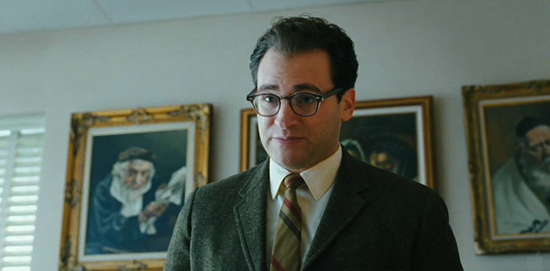


Larry’s issues at home and at work are exacerbated by his inability to deal with them. The narrative is broken down into three subtitled acts corresponding to three rabbis Larry turns to for an enlightened perspective. The Coens, however, are more enlightened because they know that a serious man’s efforts to prevent what is happening to him are futile and irrevocable. Woody Allen comes to mind when examining how the film juggles comedy and tragedy. It ultimately leans toward the latter - with a softened landing. The ending is abrupt and curious even when compared to No Country for Old Men, but it certainly sticks with you once you figure out what little you were meant to understand. The Coens, like omniscient clouds, once again cast a shadow over viewers, intimidating, confusing and mocking them. And, being the remarkably skilled filmmakers that they are, they get away with it.

BEST COEN
Blood Simple
Barton Fink
No Country for Old Men
Fargo
The Hudsucker Proxy

GOOD COEN
Miller’s Crossing
The Big Lebowski
Raising Arizona
Burn After Reading
Intolerable Cruelty

THE REST
O Brother, Where Art Thou?
The Man Who Wasn’t There
The Ladykillers


Monday, October 26, 2009

Morrissey hospitalized

British singer Morrissey, formerly of The Smiths, collapsed during a concert on Saturday and was hospitalized. He is now resting at home.


No further information regarding the reason for the collapse was released.

Morrissey collapsed during a show in England. Accounts from fans in attendance say it happened during the first song. Entertainment Weekly reported he had difficulty breathing while onstage.

The singer canceled several upcoming concerts as a result of the hospitalization.

- Via CNN and Entertainment Weekly

Wednesday, October 21, 2009

'Bored to Death' cultivates young writer fantasy


If "Entourage" is the ultimate young adult male fantasy, then HBO’s "Bored to Death" is, more specifically, a young writer’s fantasy. The writer Jonathan Ames (played by Jason Schwartzman), based on the real-life series creator-writer, decides to moonlight as a private detective after his girlfriend dumps him. (OK, that cause-and-effect motive from the pilot will never quite be convincing.)

His life: Frequenting New York Film Society social functions, getting handed scripts by Jim Jarmusch, being best friends with one’s editor, getting drunk off white wine and scenic inspiration a la Brooklyn, and having no shortage of things (good and bad) happen to him.

Despite all this, Jonathan is depressed, naïve and all too milquetoast. Thus is life as a young writer. "Bored to Death" is probably the first hipster noir, and also, obviously a comedy.

This is HBO’s second show set in Brooklyn recently – following "Flight of the Conchords." A hipster serial trend could emerge with this engaging series, which premiered Sept. 20. It disappointed in the first few weeks by taking the easy way out on more than one occasion. Five episodes in, it’s not a great mystery or a great comedy, just a good show that’s a little bit of both and sometimes neither. It works best when it isn’t trying to devise a genuine mystery – that it never quite pulls off.

George Christopher (played by Ted Danson), an avuncular magazine editor socialite (who is never seen actually working), fostered a compelling bond with Jonathan. Danson, who suddenly became TV’s foremost character actor in his golden years, steals the show here. As George, he has more luck getting his way than as himself, at 9 p.m., convincing Larry David to take a bite of cake.

The character was conceived as a cross between two journalists: the erudite, deceased George Plimpton and the hedonistic Christopher Hitchens. George eccentrically clings to the faded frisky naiveté of his 20s yet, at the same time, craves the earned status of an elder statesman.

Zach Galifinakis’ role as Ray, Jonathan’s other best friend, makes things confusing since both George and Ray are intended as comic reliefs. And yes, it is a comedy show, but George is the right kind of crazy. Ray is a confused, sensitive cartoonist with an injection of the comic’s own deranged, deadpan shtick. The character comparatively struggles to spring off the page because he’s underwritten. Galifinakis is a great comedian – just not for this show.

'The Case of the Lonely White Dove'


In the fifth episode, “The Case of the Lonely White Dove,” the series touches on all its narrative threads with fascinating maturity. The noir is in full swing as a Russian ex-con who wants to track down a lounge singer he slept with the night before he was sent to prison. Jonathan invites his ex-girlfriend to dinner at the Russian nightclub in Brighton Beach where the singer works. Jonathan is wistful, thinking he’s figured out where he went wrong with his relationship, but mixing business with pleasure never goes according to plan.

Also, George takes a cue from publisher Jann Wenner and plans to channel his bisexual side in a peculiar effort to beckon greater female readership of his mag.

One particular scene was an example of allusion overload. George’s hyper-literary male escort, played Romany Malco, broke the ice by referencing Klaus Kinski, Woody Allen’s The Whores of Mensa and Samuel Beckett while "Bored to Death"'s writers apparently got high off their own supply.

The real-life Ames' commitment to the show is admirable and unsurprising considering the affection and observation that's devoted to the depiction of the eponymous Brooklyn writer protagonist. Ames, a New York Press columnist-turned-novelist, writes or co-writes each of the series' episodes. You'd think this would lend itself to a greater homogeneity in quality among the scripts. Nevertheless, Ames' recognizable closeness behind the scenes strengthens the series' concoction of the writer fantasy.

In episode no. 5, the mystery, specifically the boardwalk scenes, was the most complex it’s been so far this season and could have stood alone. And yet, there was still ample time devoted to Jonathan’s relationship and Ray’s failed attempts at intimacy. And even George learned something. More impressive? Ames managed to conceptualize his vision of Brooklyn as an evocative fantasy world. "Bored to Death" suffered creatively at the worst possible time – at the beginning of the first season when it should be luring viewers not lulling them to sleep. But it has improved (and with the viewership flock came a second-season renewal), and just like the path of any young struggling writer, it needs to be given a chance.


"Bored to Death" airs Sundays at 9:30 p.m. EST on HBO.

PFF Review: The Men Who Stare At Goats

(Grant Heslov, 2009) - Out in theaters November 6.


George Clooney, the perfect athlete in American cinema – a favorite and an underdog at the same time – stars in another very smart film about the government. The Men Who Stare at Goats – based on Jon Ronson’s nonfiction study of the U.S. Army’s experiment with trained psychic ‘Jedi warriors’ – generates most of its laughs from the fact that it's based on truth. Bill Django (Jeff Bridges) has a spiritual experience while fighting in Vietnam and soon founds the New Earth Army with Lyn Cassady (Clooney) as a prodigious psychic. Ewan McGregor plays the journalist who learns the history of this underground unit and spends most of the movie wandering the Kuwait border with Cassady. Plentiful flashbacks are often hilarious and informative. The film, a well-cast crowd pleaser, never assumes that it is a political piece above a comedy. Even if it isn’t grandiose with its satire like Dr. Strangelove or rapid-fire in its comic delivery like In the Loop, it doesn’t have to be. Festival runs should give Goats a word-of-mouth boost if it even needs it.

Apollo's Rating: 8 out of 10 (Reviewed at the Philadelphia Film Festival)

Running time: 93 mins.


Tuesday, October 20, 2009

The real Death Race

[Editor's note: Remember Death Race, that remake of Death Race 2000 with Jason Statham? Me neither. Here, Chris Fusco chronicles the adventures of a food industry professional who tries his hand at something a bit different: defying the Grim Reaper in a real death race.]

When asking any restaurant employee about what they do in their free time, the typical answers usually involve sports, going to the bar, and the occasional recreational drug habit. However, one of my co-workers has chosen a slightly different path: to push himself to insane extremes to test his physical limits. Apollo's Cred has been asked to follow Jonathan Latayan and his second attempt at the Toughguy race that takes place in Wolverhampton, England. So, for the next few months, I will follow Jon as he trains to prepare himself for this feat of lunacy.


More after the jump.


A few weeks ago, Jon started his official training for the race. After he showed me the "Death Waiver" he had to sign, I realized this event meant business. Jon kept a journal throughout his training for his first attempt at the Toughguy race, which tells the story of a rigorous marathon that few dare to attempt and even fewer complete. Jon was a lucky one: he only sustained a few pulled muscles, including a quad and both hamstrings, and finished in 228th place.

That was summertime, when the water isn't quite as bone numbingly cold and the race course is much more manageable.

This race is not only a test of physical endurance but mental endurance. Competitors slide down muddy hills into freezing cold water, make their way through through electrified wires, and climb up and down wooden obstacles, cargo nets, concrete walls, fire pits, and mud. The race also involves running through multiple smoke bombs, shot from 18th century cannons, running up and down nettle-infested fields, through pits full of animal dung and "puddles" eight feet deep.

After watching some videos of the race, I have come to the conclusion that this is not only race for the fittest but also to most lunatic. People are out in the freezing cold weather, getting torn apart physically by obstacles, some while wearing almost nothing at all. Jon, as I know, is very extreme when in comes to everything, and very physically fit, riding his bike from Queens to work almost every day. While most participants' goals are to just finish the race in one piece, Jon's goal is to finish the race in under two hours, which he thinks is attainable. We'll see.

Monday, October 19, 2009

Jim Morrison's ghost haunts rock historian

A man who visited Jim Morrison's grave in France at the Père Lachaise cemetery is now haunted by his ghost, according to the U.K.'s Daily News.  The haunting apparently started when the man, rock historian Brett Meisner, had his picture taken at the grave.  Morrison's ghostly image showed up in the background and then all hell broke loose in his life, which Meisner believes is the result of the haunting.


Meisner had the photo analyzed, and the result was as he expected: the only explanation for the blurry smudge in the background is ghost haunting. Clearly.

- Via Rolling Stone Rock & Roll Daily

Saturday, October 17, 2009

Shawn gets shot in 'Psych' fall finale

I wonder which TV exec invented the "fall finale."

I'd like to punch him out a second story window.

Several of the television shows I enjoy have had mid-season hiatuses in the past few years. Lost loves to do it. Burn Notice and Leverage both did it. Today was the fall finale of Psych, the oddball detective show that makes me wonder how anyone could suffer through another episode of Law and Order.

Why cut a good season in half?  To double the number of "finale" episodes?  To trick viewers into watching the show that fills in the resulting empty time slot (USA's new drama, White Collar, in this case)?  It's mostly just annoying.

The good news, I suppose, is Psych will be back with new episodes in January. The season's not over, so I don't have to wait eight months for a new episode.

Episode 4.09, "Shawn Takes a Shot in the Dark," tones down the humor in exchange for some tense moments. Shawn's been kidnapped and stuffed in a trunk, so there's less opportunity for his comedic riffing with Gus. A flashback does give Shawn a chance to refer to Gus as "Doughnut Holstein," at least.  Also, a nice 1970 Plymouth Road Runner has a starring role in the episode.


As for the music: the episode features the abbreviated version of the Psych theme.  The best musical moment occurs at the climax of the episode, in the last 10 minutes of the show.  It's "Welcome All Again" by Collective Soul, the opening track from the band's newly released self-titled record.  Remember "Shine" and "Heavy" and "December" from '90s alt-rock radio?  Yeah, those guys.  The new song's good and it's used well in the scene.